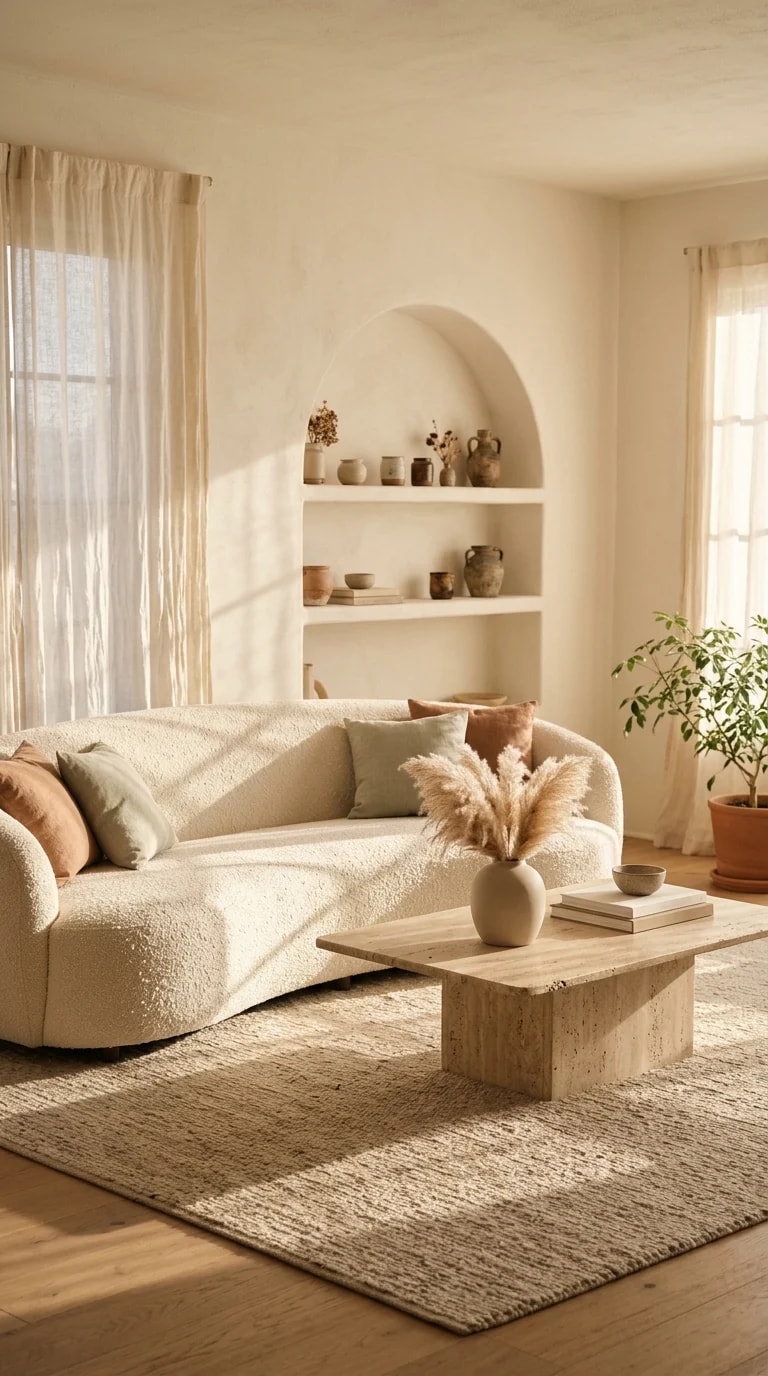
Minimalism has a reputation problem, and it comes from edges. All those hard right angles, glossy white surfaces, and empty stretches of wall can read as a showroom rather than a home. The room in this photograph solves that problem without adding clutter: almost every major element is curved. A cream bouclé sofa bows outward in a single soft sweep. Behind it, an arched built-in niche carves a rounded silhouette out of a flat wall and gives the eye somewhere gentle to land. Nothing here is sharp, and yet nothing is fussy either.
The palette does the same quiet work. Ivory, sand, and warm wood form the base, with sage and rust showing up only in the throw pillows and a few ceramic vessels. That restraint matters more than any specific hue — three or four tones repeated across textiles, wood, and pottery will always feel calmer than a dozen competing colors. Notice how the pampas grass echoes the beige rug, how the terracotta bowl picks up the rust cushion. Repetition, not variety, is what makes a limited palette feel intentional rather than sparse.
Texture carries the weight that pattern usually would. Bouclé has that nubby, hand-made quality that invites touch, and it sits against a chunky low wood table with visible grain, a woven rug, and sheer curtains that soften the daylight into a haze. When you strip a room down to its essentials, every remaining surface gets read more closely, so it pays to choose materials with something to say. Smooth plaster, rough linen, matte clay, oiled oak — four textures will do more for warmth than four more pieces of furniture ever could.
The built-in arch deserves its own note. It replaces what would otherwise be a blank wall or a hung gallery, holding a small collection of ceramics without asking for extra floor space. Objects grouped in one recessed niche read as a deliberate composition; the same objects scattered across three surfaces would read as clutter. If you are working with a plain room, consider a shallow arched recess, a rounded mirror, or even a doorway trim in a soft curve. It is a small architectural gesture that changes the entire mood of a wall.
Finally, the room keeps its center open. The coffee table is low, the seating hugs the perimeter, and the rug leaves a clear walking path. That emptiness is not a lack of ideas — it is the thing that lets the curves, the textures, and the daylight breathe. Soft minimalism is not about owning less for its own sake; it is about choosing the few shapes and surfaces you actually want to live with, then giving them enough room to be seen.