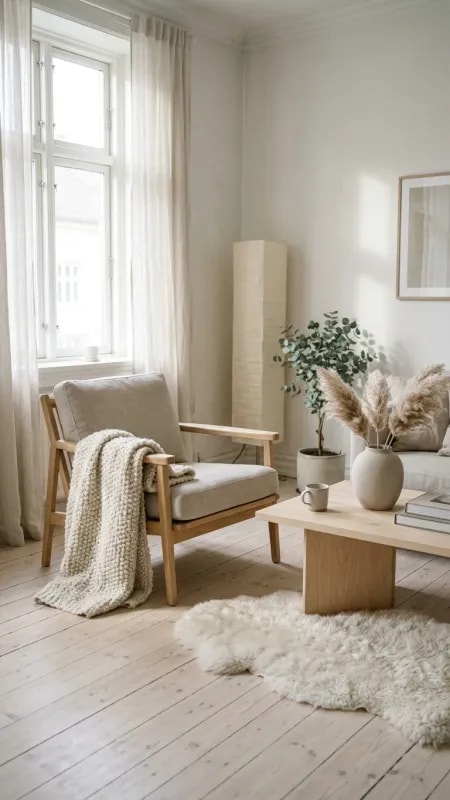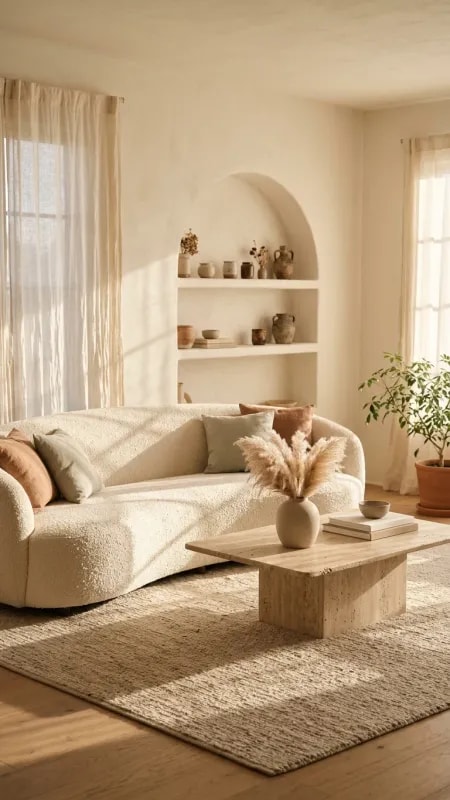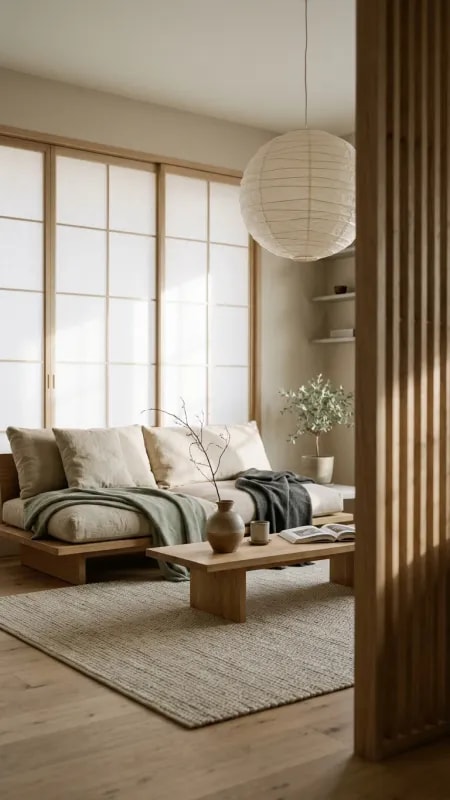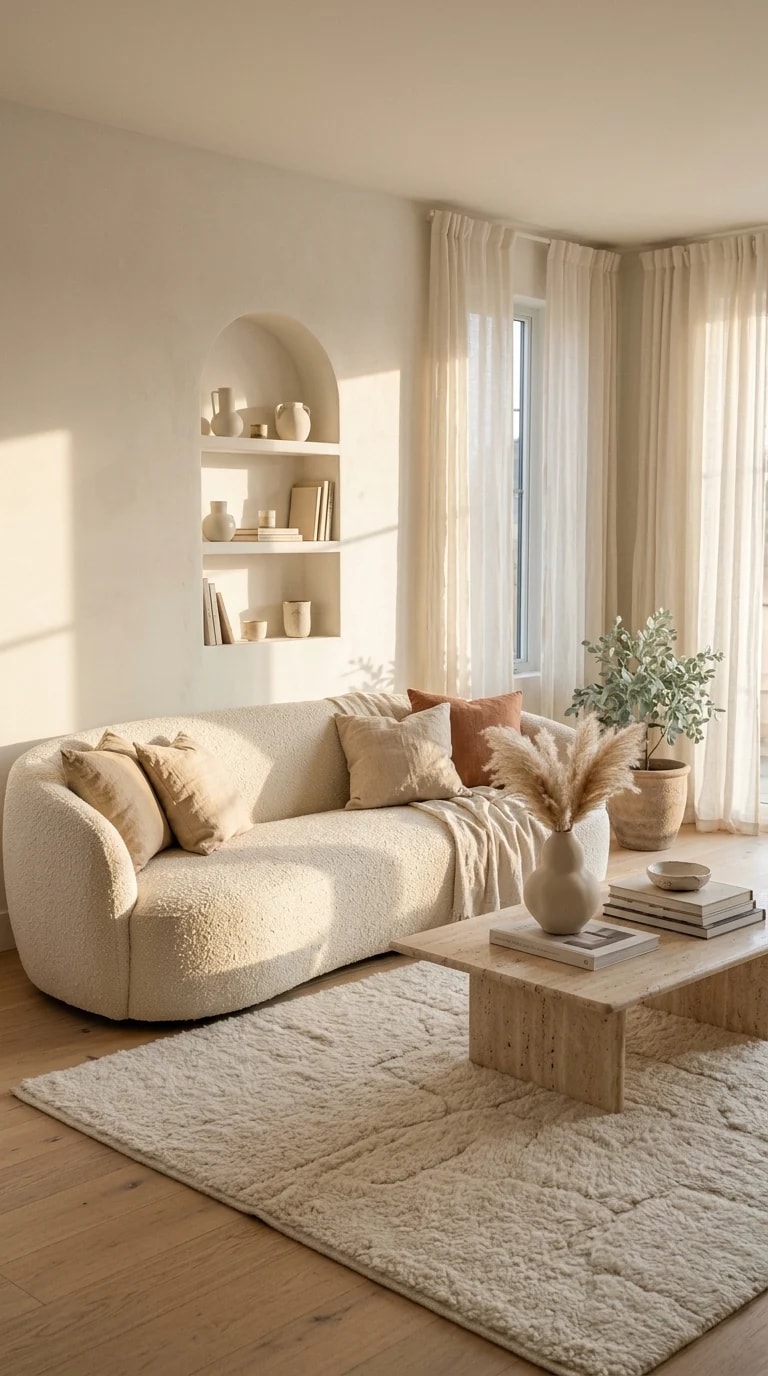
A corner like this one is easy to misread as empty. Count what's actually there: a rounded sofa, a low table, a rug, a niche of ceramics, one plant, a curtain that pools at the floor. Six elements doing the work of twenty. That's the quiet mechanism behind good minimalist home design — it isn't about having less for the sake of a photograph, it's about giving each object enough breathing room to be noticed. Remove the clutter and the shape of the room, the grain of the floor, the path of the afternoon sun all become visible again.
Texture is what keeps a neutral palette from going flat. Notice how many surfaces are working in the same narrow range of cream, sand, and taupe: the nubby loop of the bouclé sofa, the pitted matte of the travertine table, the gauze of the sheer curtain, the dense pile of the rug, the dry rustle of pampas grass in a basket. Pick one color family and let the materials argue among themselves. Add a single muted green from the plant and a thin line of terracotta, and the whole scheme reads warm rather than clinical. If a room feels cold, the answer is almost never more color — it's more texture.
The arched niche is the smartest move here. A shallow recess does the job of shelving, art, and a sideboard at once, without a single object protruding into the walkway. Inside it, restraint rules: a few ceramic vases in slightly different heights, a small stack of books, and a deliberate patch of nothing. That empty space is what makes the objects look chosen instead of accumulated. The arch also repeats the curve of the sofa, and repetition of a single soft shape is one of the cheapest ways to make a room feel designed.
Then there's the light. Sheer floor-length curtains filter the sun without killing it, so it rakes across the wall in long diagonals and shifts hour by hour. Treat that moving shadow as part of the decoration and place furniture where it can catch it — here the sofa sits square in the beam, which is why the cushions look so inviting. Light wood flooring underneath keeps the shadows from turning grey.
To borrow the approach, start by subtracting rather than shopping. Clear one surface completely, choose a palette of three neighboring neutrals, then layer in four or five textures and one curved form. Add a plant, a woven basket, a stack of books you actually read, and stop there. Cozy order, not emptiness, is the goal — a room that invites you to sit down and slow the afternoon out.