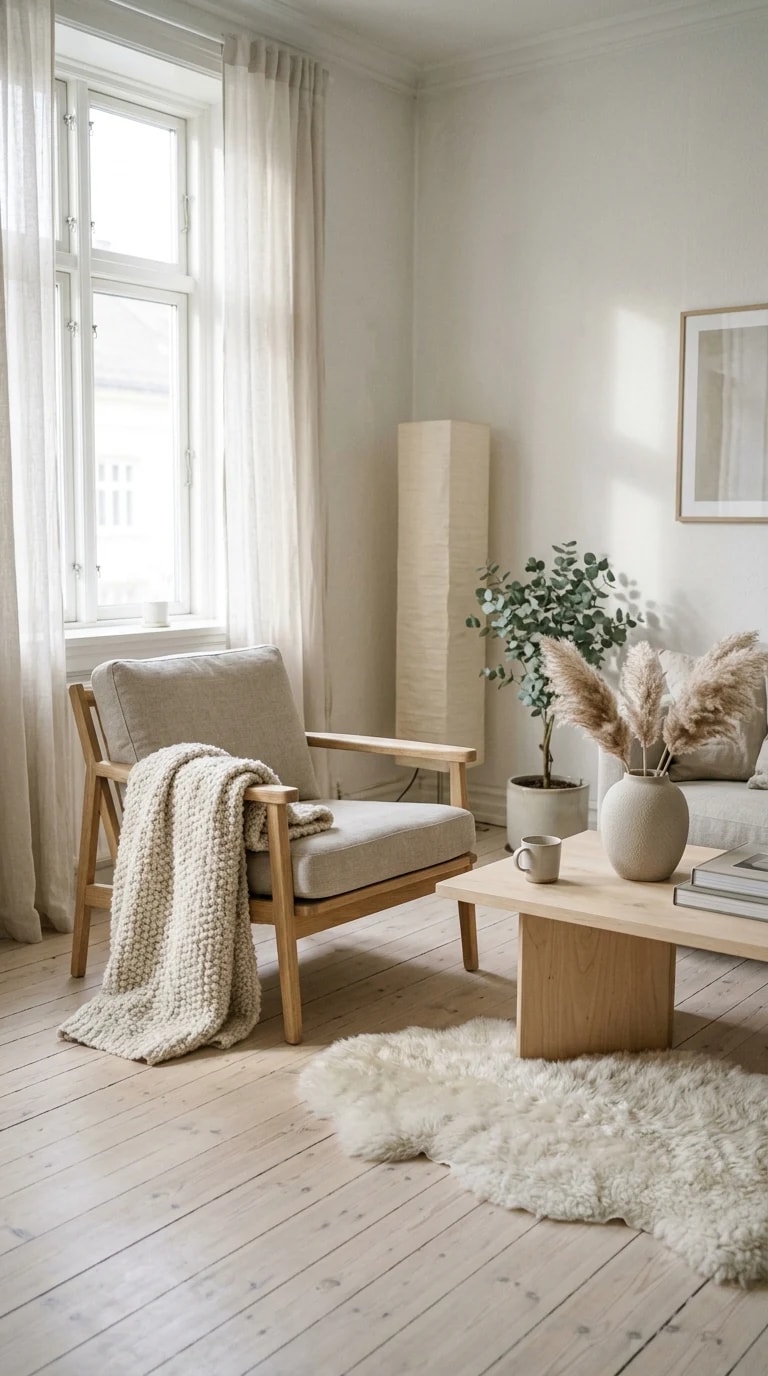
There is a particular kind of calm that only shows up when a room stops trying. This corner has it: a light oak armchair pulled close to a window, a chunky knit blanket spilling over one arm, a low table holding nothing more dramatic than a mug, a few design books, and a vase of dried pampas grass. Nothing matches. Nothing shouts. Yet the whole scene reads as finished, and that is the quiet trick of rustic modern home design. It is less a shopping list than a ratio, roughly one part rough, organic texture to three parts clean, breathing space.
The materials do most of the talking. Wide-plank floorboards in a pale, matte finish run toward the light, and the chair frame is left in a similar raw oak tone, so the furniture feels grown from the floor rather than placed on top of it. Against all that smoothness, texture arrives in clusters: the loose gauge of the throw, the crimped pile of the sheepskin rug, the papery rustle of dried grass in a matte ceramic vase. The rule worth stealing is contrast by feel rather than contrast by color. Keep the palette in the white, cream, and honey range and let roughness and softness argue with each other instead.
Light is the second material here. A tall window anchors the composition, and sheer curtains filter the sun into something closer to a wash than a beam, so shadows fall gently across the boards and the wall instead of cutting hard lines. If you are recreating this, resist the urge to fill the window wall. Leave the glass as clear as you can, hang the sheer panel slightly wider than the frame so it pools, and let the chair sit close enough that you can reach the sill. Morning light on pale wood is worth more than any accessory you could buy for that spot.
Restraint is what keeps it from sliding into cabin cliché. Every object in this corner earns its place by being useful or by being genuinely beautiful, and often both. A stack of books doubles as a coaster for the mug. The plant softens the hard edge of the table without competing with the pampas. Heights stay low, which keeps the eye moving across the room rather than snagging on furniture, and the empty wall above the chair is left empty on purpose. Negative space is not a gap waiting to be decorated; it is the thing that makes the textures legible.
Start with one corner, not a whole room. Choose a pale wood tone and repeat it twice, add a single chunky textile, then subtract until the space feels unhurried. Warmth in rustic modern design rarely comes from adding more. It comes from rough surfaces, honest materials, and the confidence to leave a little air around them.